
Finding the correct elevator spare part number is one of the most important steps when purchasing elevator and escalator spare parts. A small difference in a part number can mean a completely different component, specification, or application.
For elevator maintenance companies, distributors, contractors, and spare parts buyers, knowing how to identify the correct part number can save time, reduce purchasing mistakes, and help suppliers provide accurate quotations.
In this guide, we explain where to find an elevator spare part number, what information you should provide to a supplier, and what to do if the original part number is missing or difficult to read.
What Is an Elevator Spare Part Number?
An elevator spare part number is a unique identification code assigned to a specific component by an elevator manufacturer or parts supplier.
Depending on the manufacturer, a part number may contain numbers, letters, or a combination of both.
For example, an elevator component may have information such as:
- Part number
- Model number
- Product code
- Serial number
- Manufacturing code
- Electrical specification
The exact format varies between manufacturers and product types.
The part number is important because two elevator parts may look almost identical but have different dimensions, mounting methods, electrical specifications, or applications.
Therefore, when ordering elevator spare parts, it is much safer to identify the exact part number rather than relying only on the product name.
Why Is the Correct Part Number Important?
Using the correct elevator spare part number can help you avoid several common purchasing problems.
1. Avoid Ordering the Wrong Part
An elevator door roller, photocell, push button, or door motor may have several similar versions.
The part number helps distinguish between different models.
2. Improve Supplier Communication
When you provide an exact part number, an elevator parts supplier can usually identify the product much faster.
Instead of several rounds of questions, the supplier can check:
- Product specifications
- Compatibility
- Availability
- Price
- Lead time
3. Get a More Accurate Quotation
A product name such as “KONE door roller” may not be specific enough.
There may be multiple KONE door rollers for different elevator systems.
Providing the part number allows the supplier to quote the correct product.
4. Reduce Delivery Problems
Ordering the wrong part can result in additional shipping costs, returns, delays, and downtime.
Correct part identification before payment can significantly reduce these risks.
Where Can You Find an Elevator Part Number?
There are several places where you may be able to find the correct elevator spare part number.
1. Check the Original Part
The first place to look is the original component.
Many elevator parts have identification information printed, engraved, stamped, or attached to the product.
Look carefully at:
- Labels
- Stickers
- Metal plates
- Engraved codes
- Printed markings
- Product housings
- Connectors
- Packaging
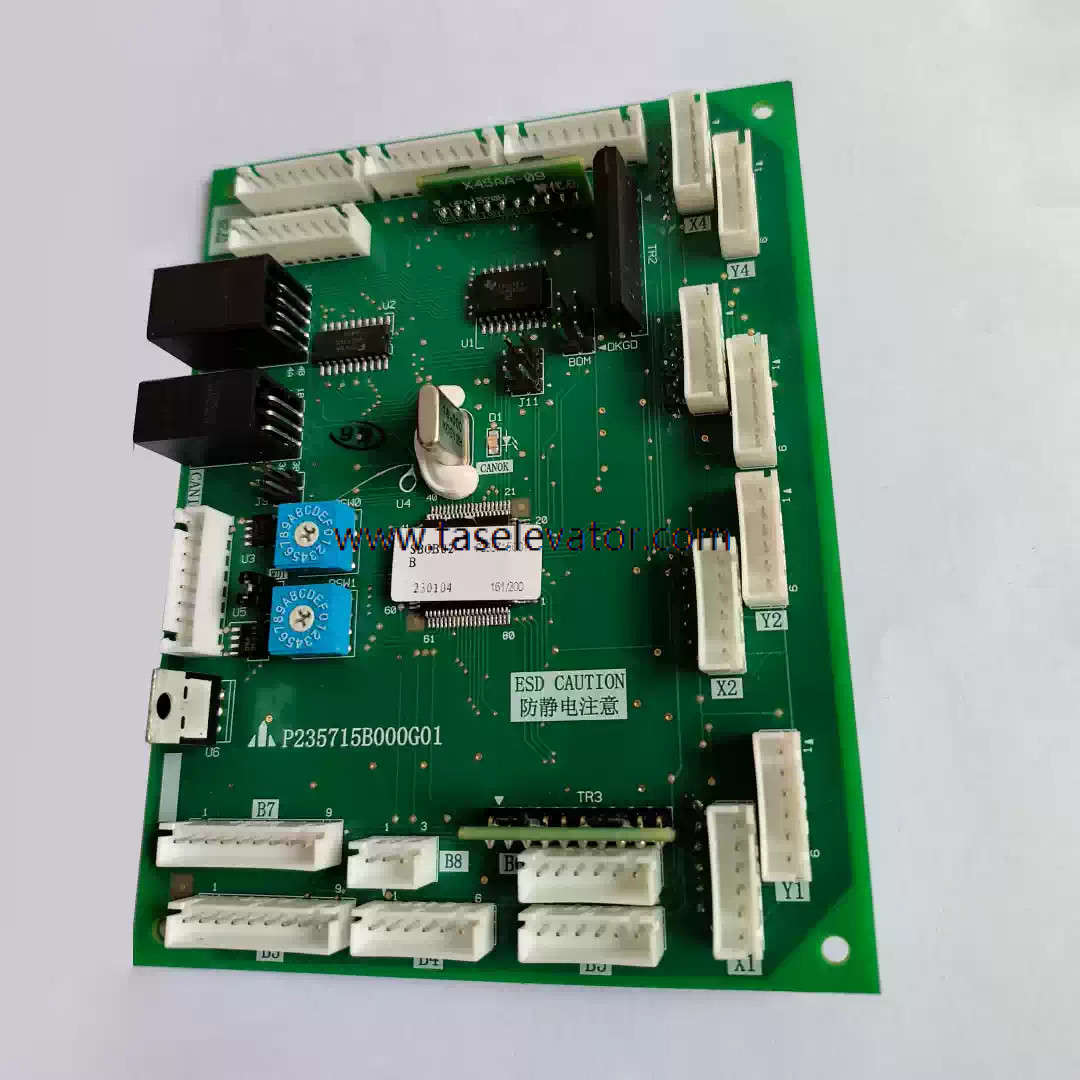
For electronic components, the part number may be printed directly on the circuit board or housing.
For mechanical components, the number may be stamped onto a metal bracket or attached to a label.
Take a clear photo of the complete component and a close-up photo of the identification label.
2. Check the Original Packaging
If the original elevator spare part has already been removed, check whether the packaging is still available.
The product box, plastic bag, label, or carton may contain important information such as:
- Part number
- Product name
- Model
- Quantity
- Manufacturer
- Batch number
Sometimes the part itself has no visible identification, while the original packaging has the complete part number.
This is especially useful for small elevator components.
3. Check Elevator Documentation
Elevator technical documents can also contain part numbers.
Depending on the elevator system, useful documents may include:
- Maintenance manuals
- Installation manuals
- Technical manuals
- Spare parts catalogs
- Wiring diagrams
- Component lists
- Service documentation
These documents may show the relationship between a component and its corresponding part number.
However, always make sure that the document applies to the exact elevator model and version you are working with.
4. Check the Elevator Model
If you cannot find the part number directly, identify the elevator brand and model first.
Common elevator brands include:
- KONE
- OTIS
- Schindler
- Mitsubishi
- Fujitec
- Hitachi
- Toshiba
- Hyundai
The elevator model can help narrow down the possible replacement parts.
For example, simply searching for “elevator door motor” may produce hundreds of different products.
But searching based on:
Brand + Model + Door Motor
can provide much more specific results.
How to Find a KONE Elevator Part Number
KONE elevator systems use many different components and replacement parts.
If you need a KONE spare part, start by checking the identification information on the original component.
You should collect:
KONE + elevator model + part number + product photo
For example, if you are sourcing a KONE door motor, provide the number printed on the motor label whenever possible.
If the number is difficult to read, take a high-resolution photo and send it to the supplier.
Do not assume that two KONE parts are interchangeable simply because they look similar.
How to Find an OTIS Elevator Part Number
OTIS elevators also use different components depending on the elevator model and system configuration.
When sourcing an OTIS spare part, check:
- Original part number
- Elevator model
- Product label
- Motor or component specifications
- Original photos
For electrical components, also record important specifications such as voltage, current, frequency, connector type, or other information shown on the original product.
How to Find a Schindler Elevator Part Number
For Schindler elevator parts, the same basic identification process applies.
Check the original component and look for:
- Part number
- Model number
- Product code
- Manufacturer information
- Electrical specifications
If the part number cannot be identified, provide the supplier with the elevator model, photos, dimensions, and installation information.
What If the Part Number Is Missing?
This is one of the most common situations for elevator maintenance companies.
The original part may be old, damaged, dirty, or have a label that has completely worn away.
Fortunately, you can still identify many elevator spare parts without the original part number.
Provide the following information to your supplier:
Product Photos
Take clear photos from different angles.
Ideally, provide:
- Front view
- Back view
- Side view
- Mounting view
- Close-up of labels
- Connector or wiring view
Dimensions
For mechanical parts, provide accurate measurements.
Depending on the product, this may include:
- Length
- Width
- Height
- Diameter
- Shaft diameter
- Hole diameter
- Hole spacing
- Wheel width
Elevator Brand
Tell the supplier which elevator brand the component belongs to.
Elevator Model
If available, provide the exact elevator model.
Application
Explain where the component is installed.
For example:
- Elevator car door
- Landing door
- Door operator
- Control cabinet
- Escalator handrail system
- Guide rail system
This information can help the supplier identify the correct replacement.
How to Take Photos for Part Identification
A good product photo can make the identification process much easier.
When photographing an elevator spare part, follow these simple rules.
Use Good Lighting
Make sure the part is clearly visible.
Avoid very dark or overexposed photos.
Take Multiple Angles
One photo may not show enough information.
Take several photos showing the front, back, side, and mounting area.
Photograph the Label Closely
If there is a label, take a separate close-up photo.
Make sure the numbers and letters are readable.
Include a Measurement
For mechanical parts, placing a ruler next to the component can provide useful reference information.
This is especially helpful when the exact dimensions are important.
Don’t Identify a Part by Appearance Alone
One of the biggest mistakes when purchasing elevator spare parts is choosing a component only because it looks similar to the original.
Two products may have:
- Similar appearance
- Similar dimensions
- Similar color
but still have different specifications.
For example, two elevator door rollers may look almost identical but have different:
- Wheel diameters
- Bearing sizes
- Shaft dimensions
- Mounting structures
- Materials
- Applications
The same problem can occur with elevator photocells, door motors, guide shoes, push buttons, and other components.
Whenever possible, verify the part number and specifications before ordering.
What Information Should You Send to an Elevator Parts Supplier?
If you want to receive a quotation quickly, provide as much relevant information as possible.
A useful inquiry could include:
Product: Elevator Door Roller
Brand: KONE
Model: XXXXX
Part Number: XXXXX
Quantity: 20 pcs
Photos: Attached
Destination: Singapore
If you do not know the part number, you can write:
We don’t have the original part number. Please identify the part according to the attached photos and dimensions.
A professional supplier can then check whether a suitable replacement is available.
Can an Elevator Spare Part Have More Than One Part Number?
Yes.
In some cases, a product may have an original manufacturer’s part number as well as a replacement or supplier part number.
There may also be updated versions of the same component.
For this reason, you should not automatically assume that a different number means the part is incorrect.
Ask the supplier to confirm whether the alternative number is:
- A replacement number
- An updated version
- An equivalent part
- An aftermarket reference
- A different specification
This is particularly important when sourcing older elevator components.
How to Verify an Elevator Spare Part Before Ordering
Before placing an order, ask the supplier to confirm the following:
Part Number
Does the quoted part number match your original component?
Compatibility
Is the part suitable for your elevator model?
Dimensions
Do the dimensions match the original part?
Specifications
For electrical products, do the voltage, current, frequency, connector, and other specifications match?
Quantity
Is the quoted quantity correct?
Product Type
Is the product OEM, original factory, or aftermarket?
Lead Time
Is the item in stock or does it require production?
Confirming these details before payment can help prevent costly mistakes.
How to Order Elevator Spare Parts From China
China is an important sourcing market for elevator and escalator spare parts.
If you are purchasing from a Chinese supplier, the process can be simple:
Step 1: Identify the Part
Find the original part number or collect photos and dimensions.
Step 2: Contact the Supplier
Send the part number, product name, photos, and required quantity.
Step 3: Confirm Compatibility
Ask the supplier to verify the replacement.
Step 4: Request a Quotation
Ask for:
- Unit price
- Quantity
- Lead time
- Packaging
- Shipping cost
- Payment terms
Step 5: Confirm the Order
Check the proforma invoice and product information carefully before payment.
Step 6: Arrange Shipping
Depending on the order size and urgency, choose express, air freight, or sea freight.
Tips for Buying Elevator Spare Parts Online
When searching for elevator spare parts online, remember that product names can vary between suppliers.
For example, the same type of component may be described as:
- Elevator door roller
- Elevator door wheel
- Door roller
- Door wheel assembly
Therefore, when searching online, try different keywords combined with the brand and part number.
For example:
KONE elevator door roller + part number
or:
OTIS elevator door motor + part number
However, online search results should only be used as a starting point. Always verify the specifications before purchasing.
Why Work With an Experienced Elevator Spare Parts Supplier?
Identifying elevator components can sometimes be difficult, especially when the original part number is missing.
An experienced supplier may be able to help you identify products based on:
- Part numbers
- Photos
- Dimensions
- Elevator brands
- Elevator models
- Product specifications
- Previous applications
This can be particularly valuable for maintenance companies and distributors that need to source multiple types of elevator spare parts.
Instead of searching for every component individually, you can provide your supplier with a list of part numbers and photos and ask them to check availability and pricing.
Elevator Spare Part Number Identification Checklist
Before sending an inquiry, prepare the following information:
☑ Elevator brand
☑ Elevator model
☑ Original part number
☑ Product name
☑ Clear product photos
☑ Product dimensions
☑ Electrical specifications, if applicable
☑ Required quantity
☑ Destination country
☑ OEM or aftermarket requirements
The more complete your information is, the faster your supplier can usually respond.
Frequently Asked Questions
How can I find an elevator spare part number?
Start by checking the original component, product label, packaging, maintenance manual, spare parts catalog, or technical documentation. If the number cannot be found, provide photos, dimensions, elevator brand, and model to an experienced supplier.
Can I identify an elevator part from a photo?
In many cases, yes. A clear photo can help identify the product, especially when the photo shows the label, mounting structure, dimensions, and overall appearance. However, final compatibility should be confirmed using the part number and technical specifications whenever possible.
What if the original part number is unreadable?
Take a high-resolution photo of the label and provide the elevator brand, model, product dimensions, and application. A supplier may be able to identify the part using this information.
Are elevator part numbers the same for every brand?
No. Different manufacturers use different part-number systems, and different elevator models may use different components.
Can I use an aftermarket part with the same part number?
An aftermarket supplier may use the original part number as a reference for compatibility, but you should still confirm the specifications and application with the supplier before ordering.
What information should I send when requesting a quotation?
At minimum, provide the product name, part number if available, quantity, elevator brand, and photos. For mechanical or electrical components, dimensions and technical specifications can also be very useful.
Conclusion
Finding the correct elevator spare part number is an important step in successful elevator maintenance and spare parts purchasing.
The best starting point is always the original part number. Check the product label, packaging, technical documents, and maintenance manuals. If the part number is unavailable or unreadable, provide clear photos, accurate dimensions, the elevator brand and model, and information about where the component is installed.
Whether you need KONE, OTIS, Schindler, Mitsubishi, Fujitec, or other elevator and escalator spare parts, accurate product identification can help you avoid incorrect orders and unnecessary costs.
If you are looking for an elevator spare part but cannot find the correct part number, send us the part number, product photo, or dimensions. Our team can help check the suitable replacement, availability, and quotation for your requirements.