
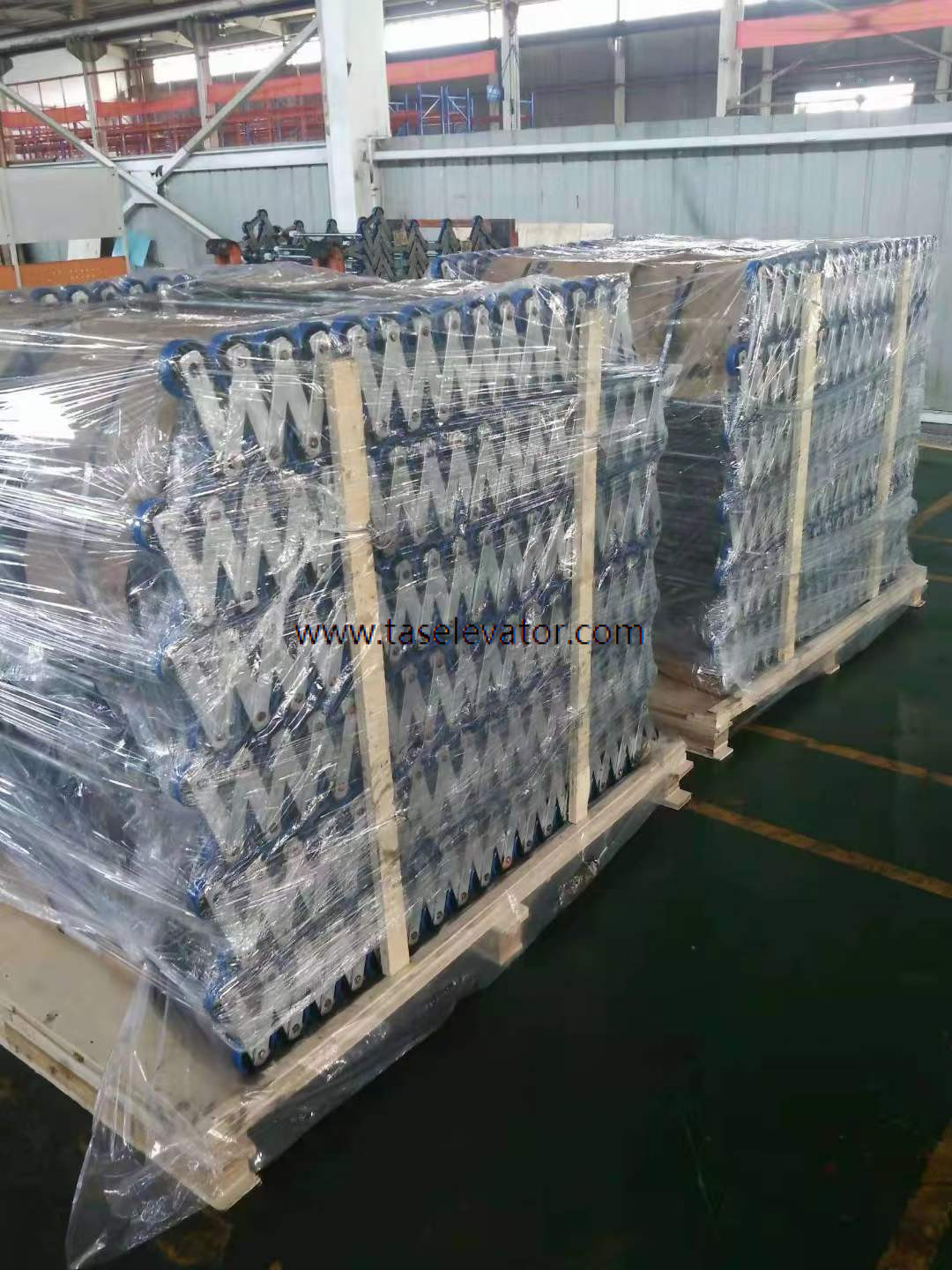
The escalator step chain is one of the most important mechanical components in an escalator. It connects and drives the escalator steps, allowing them to move continuously along the track system. Because the step chain operates under constant load and repeated movement, choosing the correct chain is essential for escalator safety, reliability, and service life.
However, replacing an escalator step chain is not as simple as choosing a standard industrial chain. Different escalator manufacturers and models may use different chain dimensions, roller sizes, pitches, attachment designs, and materials.
If you need to purchase an escalator step chain, this guide will help you identify the correct replacement.
What Is an Escalator Step Chain?
An escalator step chain, also called an escalator step drive chain, is a specially designed chain used to connect the escalator steps and move them through the escalator’s circulating track system.
Unlike ordinary roller chains, escalator step chains are designed specifically for escalator applications. They typically include:
- Chain links
- Pins
- Bushings
- Rollers
- Step attachments
- Connecting components
- Special corrosion-resistant or wear-resistant materials
The chain must work together with the escalator’s sprockets, step rollers, tracks, and other components. Therefore, even a small dimensional difference can cause installation or operating problems.
Why Choosing the Correct Step Chain Is Important
Using the wrong escalator step chain can result in several problems.
1. Installation Problems
If the chain pitch or attachment dimensions are incorrect, the chain may not connect correctly to the escalator steps.
2. Abnormal Noise
Incorrect dimensions or poor-quality rollers can cause abnormal noise during operation.
3. Uneven Step Movement
A chain that does not match the original sprocket or track system may cause unstable or uneven movement.
4. Accelerated Wear
An unsuitable chain can increase wear on the chain, sprocket, rollers, and other components.
5. Safety Risks
Because the step chain is part of the escalator’s step drive system, incorrect replacement parts may create serious operational and safety problems.
For these reasons, accurate identification should always come before purchasing an escalator step chain.
1. Check the Escalator Brand and Model
The first step is to identify the escalator manufacturer and model.
Common escalator brands include:
- KONE
- OTIS
- Schindler
- Mitsubishi
- Hitachi
- Fujitec
- Toshiba
- ThyssenKrupp
- Hyundai
The same manufacturer may use different step chains on different generations or models.
Therefore, simply saying:
“I need a KONE escalator step chain.”
is usually not enough.
If possible, provide the complete escalator model or equipment number.
This allows the supplier to compare the required chain with the original specification.
2. Check the Original Part Number
If the original chain has a part number, this is one of the easiest ways to identify the correct replacement.
The part number may be found on:
- Original packaging
- Maintenance documents
- Equipment drawings
- Spare parts catalogs
- Previous purchase records
- Manufacturer documentation
When contacting a supplier, provide the complete part number, including letters, numbers, and suffixes.
A small difference in the part number may indicate a different specification.
3. Measure the Chain Pitch
One of the most important dimensions is the chain pitch.
Chain pitch is the distance between the centers of two adjacent chain pins.
A simplified measurement can be taken by measuring the distance between several pins and dividing the total distance by the number of pitches.
For example:
If the distance across 10 pitches is 250 mm:
250 ÷ 10 = 25 mm pitch
However, the measurement should be performed carefully because worn chains may have slight elongation.
For used chains, it is better to measure several sections and compare the results rather than relying on a single measurement.
4. Measure the Roller Diameter
The roller is another critical component.
Measure the outside diameter of the chain roller using a vernier caliper.
You should record:
- Roller outside diameter
- Roller width
- Roller material
- Roller type
The roller must work correctly with the escalator track system.
If the roller diameter is incorrect, the step chain may not move properly through the track.
5. Measure the Chain Width
The chain width should also be checked.
Depending on the design, you may need to measure:
- Inner width
- Outer width
- Plate thickness
- Distance between side plates
Do not rely only on visual comparison.
Two chains may look almost identical but have different dimensions.
6. Check the Step Attachment
Escalator step chains are different from ordinary chains because they are usually connected to the escalator steps through special attachment structures.
Therefore, check:
- Attachment type
- Attachment spacing
- Mounting hole diameter
- Hole-to-hole distance
- Attachment height
- Connection method
If you are replacing the complete step chain, the attachment dimensions must match the existing escalator step.
A chain with the correct pitch but the wrong attachment design may still be unusable.
7. Check the Chain Length
Another important factor is the total chain length.
Depending on the escalator design, the chain may be supplied as:
- Individual links
- A fixed number of links
- A complete chain loop
- Chain sections
- Chain with step attachments
Before ordering, confirm whether you need a complete chain assembly or individual chain sections.
It is also important to confirm the number of links or total length required.
8. Check the Chain Roller Configuration
Different escalators may use different roller configurations.
For example, the chain may have:
- Single rollers
- Double rollers
- Different roller positions
- Different roller diameters
- Special guide rollers
The roller configuration should be compared with the original chain.
If possible, take clear photos from several angles and send them to the supplier.
A good supplier can often identify the chain more accurately from a combination of photos + dimensions + model information.
9. Consider Material and Manufacturing Quality
After confirming the dimensions, the next step is to consider the quality of the chain.
Important factors include:
Chain Material
High-quality steel is commonly used for escalator step chains because the chain needs to withstand continuous loads and repeated movement.
Heat Treatment
Proper heat treatment can improve the strength, wear resistance, and service life of pins, bushings, and other components.
Roller Quality
Poor-quality rollers may cause excessive noise, vibration, and premature wear.
Manufacturing Tolerance
Accurate manufacturing is particularly important for escalator chains because the chain must work together with the sprocket and track system.
For maintenance companies, buying the cheapest chain is not always the best approach. The total cost should also consider service life, maintenance frequency, downtime, and replacement costs.
Original vs. Replacement Escalator Step Chains
When purchasing a replacement chain, you normally have several options.
Original Equipment Manufacturer (OEM)
OEM chains are manufactured or supplied according to the original equipment specification.
Advantages include:
- Original specifications
- Good compatibility
- Easier identification
However, OEM parts can sometimes be expensive or have long delivery times.
Aftermarket Replacement
High-quality aftermarket chains can be manufactured according to the original dimensions and application requirements.
Potential advantages include:
- Competitive price
- Flexible quantities
- Shorter lead times
- Availability for older escalator models
However, the supplier’s manufacturing quality and dimensional accuracy are important.
Custom-Made Replacement
For older escalators or discontinued models, a custom replacement may be necessary.
In this situation, the supplier may need:
- Original chain sample
- Detailed measurements
- Photos
- Drawings
- Part number
- Escalator model
A professional supplier can use this information to identify or reproduce the required specification.
What Information Should You Send to a Supplier?
If you are not sure which escalator step chain you need, you do not necessarily need to identify every specification yourself.
Send the supplier as much information as possible.
A useful inquiry should include:
1. Escalator brand
For example: KONE, OTIS, Schindler, Mitsubishi, etc.
2. Escalator model
Provide the complete model number if available.
3. Original part number
If available, include it.
4. Photos
Take clear photos of:
- Complete chain
- Chain rollers
- Step attachment
- Chain plate
- Part number markings
5. Dimensions
Provide:
- Chain pitch
- Roller diameter
- Roller width
- Chain width
- Plate thickness
- Attachment dimensions
6. Quantity
Tell the supplier how many chains or chain sections you need.
This information can significantly reduce communication time and help prevent ordering the wrong part.
Common Mistakes When Buying Escalator Step Chains
Mistake 1: Choosing Only by Appearance
Two chains may look similar but have different pitch, roller diameter, or attachment dimensions.
Solution: Always confirm the technical dimensions.
Mistake 2: Providing Only the Brand
The same brand can have multiple escalator models and chain specifications.
Solution: Provide the model number or part number whenever possible.
Mistake 3: Ignoring the Roller
The chain itself may fit, but the roller may not match the track system.
Solution: Confirm roller diameter and configuration.
Mistake 4: Not Checking the Attachment
The chain pitch may be correct while the step attachment is different.
Solution: Measure the attachment and mounting holes.
Mistake 5: Buying Based Only on Price
A low-priced chain may have poor materials, inaccurate dimensions, or shorter service life.
Solution: Compare price together with quality, warranty, manufacturing experience, and delivery time.
How to Choose a Reliable Escalator Step Chain Supplier
When selecting a supplier, consider the following factors:
Technical Experience
The supplier should understand escalator chains rather than simply selling standard industrial chains.
Product Range
A supplier with experience in different escalator brands and models may be able to identify difficult-to-find parts more efficiently.
Quality Control
Ask about:
- Material
- Heat treatment
- Dimensional inspection
- Roller testing
- Load testing
- Quality inspection procedures
Sample Availability
For difficult or unusual specifications, a sample can help confirm compatibility before placing a larger order.
Communication
A professional supplier should be able to review your photos, dimensions, and part numbers and explain which specifications need to be confirmed.
Final Checklist Before Ordering
Before confirming your purchase, check the following:
☐ Escalator brand
☐ Escalator model
☐ Original part number
☐ Chain pitch
☐ Roller diameter
☐ Roller width
☐ Chain width
☐ Plate thickness
☐ Step attachment dimensions
☐ Chain length or number of links
☐ Quantity required
☐ Material and quality requirements
☐ Packaging
☐ Delivery time
If all of these details have been confirmed, the risk of ordering an incorrect escalator step chain will be significantly reduced.
Conclusion
Choosing the right escalator step chain requires more than simply matching the appearance or brand name. The chain pitch, roller dimensions, attachment design, chain length, and escalator model all need to be considered.
For older or discontinued escalator models, finding the correct replacement can be particularly challenging. In these cases, providing the supplier with the part number, photos, model information, and accurate measurements is the most effective way to identify the correct chain.
At Tanson Elevator Parts, we supply elevator and escalator spare parts for maintenance companies, distributors, and elevator professionals. If you are looking for an escalator step chain and are not sure about the exact specification, send us the part number, photos, or dimensions. We can check the specification, price, and availability for you.
Need help finding the right escalator step chain? Contact Tanson Elevator Parts today.